Showing posts with label new introductions. Show all posts

Tuesday, August 25, 2009

Wait Until You See.....


.....the new redbuds coming to market in the very near future. Some friends and I took a trip to Winchester on Friday and stopped to see Harold and Alex Neubauer (all I can say about their nursery is WOW!) before heading on over to see our good friend and horticulture guru, Don Shadow. Don took the time out of his busy day to treat us to lunch and then showed us to the far corners of the nursery where the best-of-the-best called to us from across the acres. One of the most beautiful was the plant pictured here--Cercis canadensis 'Rising Sun'--with golden yellow foliage providing the perfect foil for the coppery-orange new growth and all of it (old foliage and new) highlighted with brilliant, hot pink petioles! This is my kind of plant! Flowering in spring, its blossoms will be the typical redbud color.


Just as a tease, we also saw burgundy-leafed weeping redbuds, a mottled green-and-white variegated cultivar, a weeping variegated variety and perhaps my favorite of all (except for 'Rising Sun', of course) a hybrid between 'Forest Pansy' and 'Oklahoma' that had leaves that looked like deep, dark burgundy patent leather! Shiny and almost black! Yowza! Just wait til you see what's coming!


Thanks to Don for a fun day and to Harold and Alex for inviting us into the nursery on such short notice that morning. We appreciated it very much!

Saturday, May 16, 2009

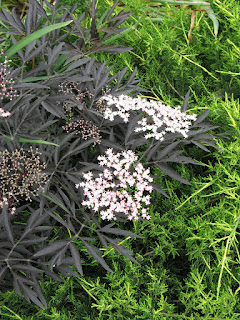
Sambucus 'Black Lace'


New from Proven Winners a few years back, Sambucus 'Black Lace' almost didn't survive my ruthless culling after it's second season in the garden. I relented at the last second and, because it had shown some signs of promise in its second year, I decided to give it one last chance. Today, I'm thrilled that I had a change of heart and let it stay.

Because most cultivars of the European elderberry don't appreciate the heat and humidity of our southern summers, I had honestly written the plant off before it ever got its roots in the ground. But it was new--and it sure was pretty in the pot--and because I've grown to trust the Proven Winners brand, I decided I needed to give it a try before I cold-heartedly wrote it off without giving at least one season to prove itself. I have to say, that first season was pretty lackluster, but being a knowledgable plantsman and gardener I knew better than to pass judgment after the first year. Sometimes a plant needs a season to settle in. So I pruned sparingly, fed copiously and waited for the results.

By spring of its second year, it was showing a little more promise. It had grown a few long and somewhat wayward shoots the previous summer, but I left well enough alone, only trimming the tips of the branches to (hopefully) help promote some additional side branching and basal growth. It did grow, albeit slowly, and it did have one or two clusters of blooms in its second spring. By autumn, though, I was growing impatient. I liked it, but did I love it enough to give it a third season??? Hmmmm...

For weeks I walked past it in the garden, each time thinking that its day had come and that I would give it a good shovel-pruning and add it to the compost pile where numerous other plants who hadn't made the cut would now feed next year's new garden additions. But every time I raised the shovel, I just couldn't go through with it. Something stopped me and I finally gave in, allowing it one more season to turn my head and show me what it really had to offer. If, however, it wasn't spectacular by the end of the third summer, into the compost heap it would go--no relenting!

I didn't have to wait for the end of the third season because 'Black Lace' has come into its own at the beginning of its third year and has proven once again to this somtimes impatient gardener that once in a while, you just have to hold your horses. Be patient. It's ferny black foliage and soft pink flowers are gracing the garden as we speak--and this little plant has proven to be t-o-u-g-h!!! If you look at the Proven Winners website and read the cultural information for the 'Black Lace' elderberry, you'll see that they say full sun and plenty of moisture, but I've actually had the opposite experience.

My trial plant is located in part shade--good morning sun, actually (which I think is better for it in the South) and is planted immediately under a 12-foot tall sweetbay magnolia (Magnolia virginiana) that sucks every drop of water from every plant within a 10-foot radius. Neighboring plants include Agave parryi, Agastache aurantiaca, Juniperus 'Gold Coast', numerous Sempervivums and Dianthus 'Bath's Pink'--all of which are immensely drought tolerant and growing within 6 feet of the water-sucking sweetbay. 'Black Lace' is not only holding it's own under these conditions, it's thriving. For the first time, the entire plant is covered in clusters of pale pink-white flowers and the new growth is showing tremendous vigor. Strong basal shoots indicate that it's really going to "bulk up" this year and by the end of summer I fully expect that it will be as beautiful as I had cautiously hoped it would be.


I sure am glad it isn't sticking roots-up out of the compost pile!

Sunday, March 22, 2009

Corylus avellana 'Red Majestic'


Since my week got away from me last week, I'm posting a second post tonight. Hope you don't mind! I've promised a new plant or product post each week, too, so here's the new plant that I'm most excited about this week. (Since you're gardeners, you do understand that my favorite plant changes at least once a week!)

Corylus avellana. "Where have I heard that name?" you may ask yourself. (Or maybe not.) Well, it may sound familiar because it's the plant that many gardeners know by its common name--Harry Lauder's Walking Stick. Actually, it's Corylus avellana 'Contorta', if I'm being 100% correct. The species itself is not contorted, only the cultivar. For many years on my trips to Europe I have lusted after the many colored-foliage forms of filbert that are grown there--particularly in the cooler parts of Europe--Holland, Germany and so on. There were golden forms, purple forms, red forms, and others, but in the heat and humidity of the southern U.S., they were crispy by the end of June, if not sooner. Not so, now.

With the introduction of Corylus avellana 'Red Majestic', we finally have a colored-leaf form of the filbert that will withstand our heat and humidity--or so they say. Time will tell, but all the reports I've heard and read so far have been very positive. And not only are the leaves red, but the stems are also contorted and twisted! The vast majority of ornamental filberts whose foliage is colored have straight stems, but not this one! It's as curly and contorted and twisted as any "Harry Lauder's" I've ever seen--like a really good "bad hair day"! Well anyway, I'm excited about it. We received 6 plants at the garden center on Thursday--apparently they're extremely limited in their availability this first year on the market, but keep your eyes peeled. You might give a quick call to your local garden centers and see if they're going to carry it. If they are, I'd suggest getting your name put on a "Wish List", if they do that sort of thing. Otherwise, you may miss out.

'Red Majestic' grows just like the green Harry Lauder's Walking Stick--about 10'-12' high and wide, preferring full sun (though I'm guessing that just a little afternoon shade in the south might be beneficial), moist but well-drained soil and some occasional pruning to help shape it (and so that you can have those fabulous branches to use indoors!). If there is any drawback, it is that the plant is grafted. This is the quickest and most efficient way to propagate this plant and get it to market, but it has one negative. The rootstock is from the regular filbert (non-contorted) and the thing suckers like mad! My new plant is in a 3-gallon pot and is only about 24" tall and already it has suckers sprouting from the base. I chose one that has about 4" of trunk at the base of the plant so that I can plant it deep and bury the graft. Hopefully, that will help reduce the amount of suckering somewhat, but I'm sure that it won't eliminate it completely. Occasionaly sucker removal is a small price to pay though, for such a beautiful little garden plant! Get on the phone first thing in the morning and track one down!
Photo from Hale and Hines www.haleandhines.com

Friday, October 3, 2008

Rudbeckia 'Henry Eilers'


Well, I've done it! I've found ANOTHER new favorite plant. Are you surprised? I didn't think so. This time it's a Rudbeckia.
Rudbeckia is a genus that I have always been incredibly fond of. Rudbeckias get a bad rap sometimes because of the market saturation by 'Goldsturm' (which is an outstanding plant, by the way.) There are, however, a LOT of other rudbeckias out there, many of which are simply fabulous garden plants. 'Henry Eilers' is no exception.

I first saw this plant on a garden tour in Columbus, OH about a year ago and was incredibly impressed by it then. We were able to get a few plants of it this spring at the garden center and I planted a few in the display garden where it performed very satisfactorily and was stunning this fall when paired with the royal purple berries of the American beautyberry (Callicarpa americana) that it had woven its way through during the course of the summer.

Where it really performed, though, was in the garden at Christ Church Cathedral in downtown Nashville. I'm not sure if it was the exposure, the irrigation, the good soil, the extra fertilizer or a "perfect storm" of all of the above, but 'Henry Eilers' was the buzz of the garden from July onward and is just now (Oct. 3) finishing up its show!

It's a little taller than some rudbeckias, but considerably shorter than others, so it makes a nice middle-of-the-border plant. When it reaches blooming height, about 4 feet, it's just a tiny bit on the lax side, so I'd recommend pairing it with something shorter and sturdier in front of it that will give it a bit of support. Or pair it with a shrub like the beautyberry in a way that the stems of the rudbeckia can grow up just through the edge of the shrub and be supported that way. Otherwise, you may have to stake. (Well worth any effort it might take.)

In the display garden at Moore & Moore (http://www.mooreandmoore.com/) it was in a leaner, drier part of the bed, so that may have accounted for it being just slightly, slightly less showy. In the other location it was in the richest, blackest, most organic, well-fertilized and irrigated soil we could give it and it absolutely shined! You can see for yourself in the photos above, and I think you'll agree. Put this one on your list for next year! See you in the garden!